How Much Does YouTube Pay per 1,000 Views?

By TubeScope Editorial Team · 2026-06-14 · 10 min read

Most YouTube channels earn somewhere around

to $3 per 1,000 views after YouTube takes its cut — but that average hides an enormous range. A music channel might make under a dollar per thousand views, while a finance channel can clear $8 or more for the exact same view count. The single biggest factor isn't how big the channel is; it's the niche — and, just as much, the country the audience is in. Here's how YouTube payments actually work, the real rates, and how to estimate ad, sponsorship, and affiliate income.

Want the number for your own channel right now? Skip to the free YouTube Money Calculator — enter your views, niche, and audience country and it estimates ad revenue, sponsorship value, and affiliate potential in one place. The rest of this guide explains where those numbers come from.

What's the short answer?

There's no flat per-view rate. What a creator earns depends on what advertisers are willing to pay to reach that audience — and that varies wildly by topic, audience country, and time of year. As a rough rule:

–$3 per 1,000 views is typical, with low-value niches under
and high-value niches well above $5. To understand why the spread is so big, you need two terms: CPM and RPM.

CPM vs RPM — what's the difference?

These two acronyms cause most of the confusion about YouTube money:

  • CPM (Cost Per Mille) is what advertisers pay per 1,000 ad impressions. It's the "headline" rate you'll see quoted everywhere.
  • RPM (Revenue Per Mille) is what the creator actually keeps per 1,000 video views, after YouTube's cut and after accounting for views that didn't show an ad at all.

The key fact: on long-form videos, YouTube keeps about 45% of ad revenue and pays the creator the other 55%. So a creator's RPM is always meaningfully lower than the CPM advertisers pay. When someone says "YouTube pays $X per 1,000 views," they usually mean RPM — the take-home number.

Average CPM by niche

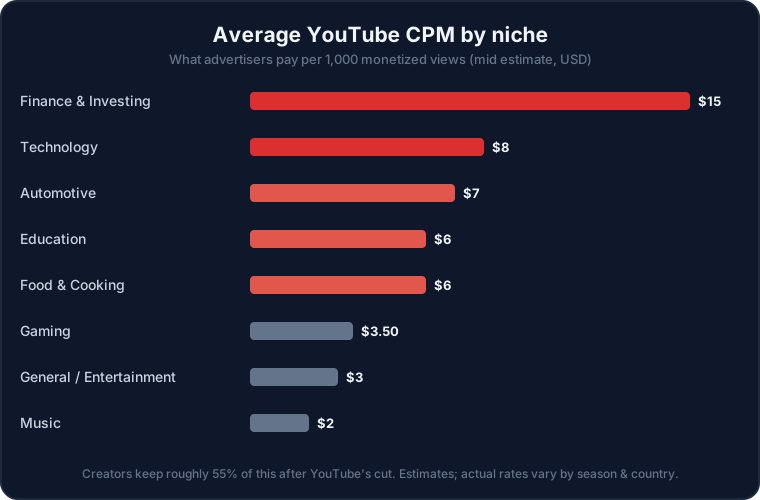
Because advertisers pay more to reach some audiences than others, CPM swings hard by category. A viewer who watches investing content is worth far more to an advertiser than a viewer watching a music video — so the same 1,000 views earn very different amounts:

Bar chart of average YouTube CPM by niche: Finance and Investing <div id=5, Technology $8, Automotive $7, Education $6, Food and Cooking $6, Gaming $3.50, General and Entertainment $3, Music
" width="760" height="500" loading="lazy" />
Mid-estimate advertiser CPM by niche. Creators keep roughly 55% of these figures.

The pattern is consistent: finance, technology, education, and business top the table because they attract high-value advertisers (brokerages, software companies, universities). Music, gaming, and general entertainment sit at the bottom — huge audiences, but cheaper ad inventory. This is why a mid-size finance channel can out-earn a far larger gaming channel.

So what does a creator actually keep?

Apply the 55% creator share to those CPMs and you get the real take-home RPM. Here's the same one million views in two different niches:

  • Gaming channel — 1,000,000 views × $3.50 CPM × 55% ≈
    ,900
  • Finance channel — 1,000,000 views ×
    5 CPM × 55% ≈ $8,250

Identical view counts, more than a 4× difference in ad revenue — purely because of the niche. That's the most important thing to understand about YouTube earnings.

Earnings by niche, at a glance

Here's what 1,000,000 views earns in ad revenue alone across common niches, using mid-range CPMs and the 55% creator share:

NicheTypical CPMCreator RPMAd revenue / 1M views
Finance & Investing
5
~$8.25~$8,250
Technology$8~$4.40~$4,400
Education$6~$3.30~$3,300
Gaming$3.50~
.93
~
,925
Entertainment$3~
.65
~
,650
Music ~
.10
~
,100

It's not just ads: the three income streams

Ad revenue is the number everyone quotes, but for most established creators it's the smallest of three streams. A realistic earnings picture combines:

  • Ad revenue — the most predictable. (views ÷ 1,000) × CPM × 55%. Think of it as the floor.
  • Sponsorships — usually the biggest. Brand deals are priced on a "rate card" of roughly
    0–$50 per 1,000 views of the sponsored video, with high-value niches (finance, tech, beauty) at the top. A single deal can outearn a whole month of ads.
  • Affiliate income — promoting products for a commission. Highly niche-dependent: tech and finance channels with high-ticket products can earn more from affiliates than from ads; music channels earn almost nothing.

Our Money Calculator estimates all three at once, so you see the full picture instead of just the ad slice.

Why audience country changes everything

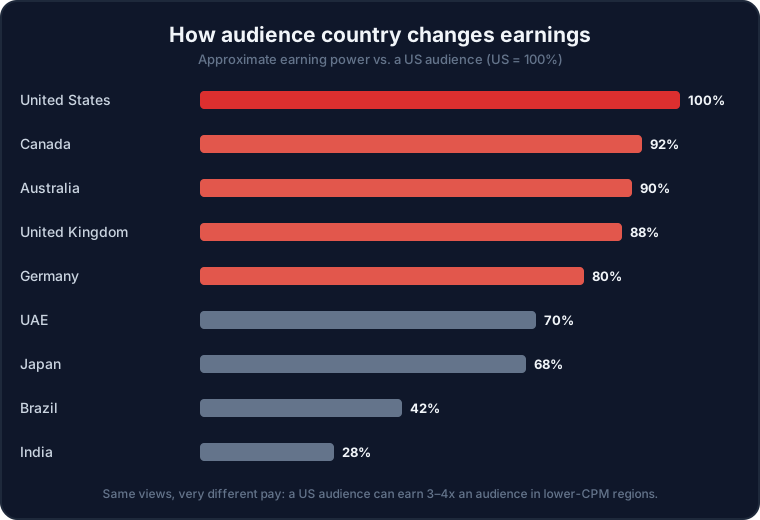
Two channels with identical views can earn very differently depending on where their viewers are. Advertisers pay far more to reach viewers in the US, UK, Canada, and Australia than in many other markets, so audience location alone can swing earnings by 3–4×:

Bar chart of relative YouTube earnings by audience country as a percent of the US rate: United States 100, Canada 92, Australia 90, United Kingdom 88, Germany 80, UAE 70, Japan 68, Brazil 42, India 28
Approximate earning power by audience country, relative to a US audience.

This is why a creator with a million US views can outearn a creator with five million views in a lower-CPM region. When you estimate earnings, the audience's country matters as much as the niche — which is why the calculator asks for both.

A realistic example

Take a technology channel with 500,000 monthly views and a mostly-US audience:

  • Ad revenue: 500 × $8 × 55% ≈
,200/month (~
6,000/year) — steady and predictable.
  • Sponsorships: two sponsored videos a month averaging 80,000 views at a $30 rate card ≈ $4,800/month — the largest piece.
  • Affiliate: gear and software links might add
    ,000–$3,000/month.
  • Total realistic income: roughly $8,000–

    0,000 a month — and notice ad revenue is the smallest of the three. That's the typical pattern once a channel is established. (Figures are illustrative; use the calculator to model your own numbers.)

    What these numbers leave out

    Ad revenue is only one income stream, and for many creators it's not even the biggest. A realistic picture of a channel's total income also includes:

    • Sponsorships — often the largest source for mid-to-large channels
    • Merchandise, memberships, and Super Thanks
    • Affiliate links
    • Audience country — views from the US, UK, Canada, and Australia pay much higher CPMs than many other regions, so two channels with identical view counts can earn very differently
    • Shorts — monetized through a separate pool and generally pay far less per view than long-form

    So treat any per-view estimate as the ad-revenue floor, not a creator's full income.

    How to estimate any channel

    The fastest way is the free YouTube Money Calculator: enter monthly views, pick a niche and audience country, and it returns ad revenue, sponsorship value, and affiliate potential with low–high ranges — or search any channel and it auto-fills the numbers for you. Prefer to do it by hand? Take recent average views, multiply by the niche CPM, and apply the 55% share for ads, then add a sponsorship rate-card figure (

    0–$50 per 1,000 views) and any affiliate income. For the full formula and sources, see our methodology; to inspect a channel's views and engagement first, run a channel audit.

    The quick takeaways

    • Typical take-home is ~
      –$3 per 1,000 views (RPM), but niche changes everything.
    • CPM = what advertisers pay; RPM = what the creator keeps (after YouTube's ~45% cut).
    • Finance and tech CPMs can be 5–8× higher than music or gaming.
    • Ad revenue is usually the smallest piece for established creators — sponsorships and products earn more.
    • Audience country matters as much as niche.

    Curious what a specific channel earns? Estimate it free with the Money Calculator, or browse the top channels by category to compare niches.

    Frequently asked questions

    How much does YouTube pay for 1,000 views?

    Typically about

    –$3 per 1,000 views in ad revenue after YouTube's cut (RPM), but it ranges from under
    in low-CPM niches like music to $8 or more in finance. Audience country also matters: the same 1,000 views from a US audience can pay 3–4× what they pay from a lower-CPM region.

    How much does YouTube pay for 1 million views?

    In ad revenue alone, roughly

    ,100 for a music channel up to $8,000+ for a finance channel, based on typical CPMs and the 55% creator share. Sponsorships and affiliate income are usually added on top and often exceed the ad revenue.

    What is a good YouTube CPM?

    CPM is what advertisers pay per 1,000 monetized views. A CPM above about $4 is healthy; finance, tech, and education routinely see $6–

    5+, while music, gaming, and general entertainment sit lower at
    –$4. Your take-home (RPM) is roughly 55% of CPM.

    Do YouTube Shorts pay the same as long videos?

    No. Shorts are monetized through a separate revenue pool and generally pay far less per view than long-form videos. A channel whose views are mostly Shorts will earn much less than the long-form estimates above.

    Why do two channels with the same views earn different amounts?

    Three reasons: niche (advertisers pay more for finance or tech viewers than for music), audience country (US/UK/CA/AU pay higher CPMs), and how the channel monetizes — sponsorships and affiliate income vary enormously between creators with identical view counts.

    Try it yourself: Money Calculator · Channel Audit · Top Channels

    ← All articles