How to Audit a Competitor YouTube Channel in 10 Minutes (Worked Example)
By TubeScope Editorial Team · 2026-09-08 · 9 min read
A competitor audit answers one question: what is this channel actually doing that works, and how much of it applies to me? You can get a defensible answer in ten minutes with four free tools and no access to their analytics. Below, the whole process is run for real on Steve Mould, a science channel with 3.6M subscribers, using public data as it stood on September 8, 2026. Every number is real; swap in any channel you like.
Minutes 0–2: the audit grade
Start by putting the channel into the Channel Audit. It returns a health grade built from three public signals: upload consistency, engagement, and momentum. Do not stop at the letter — the breakdown is the point.
For Steve Mould the upload list tells the consistency story immediately: roughly one long-form video a month, 2 in the last 30 days and 5 in the last 90, each 16 minutes or so. That is a low-frequency, high-effort channel, and the audit reads it as steady rather than sparse because the gaps are regular. A channel that posted five videos one month and none the next would score lower on the same total.
Momentum needs more care. The ten most recent uploads average 2,164,900 views; the ten before them average 3,228,900, a ratio of 0.67. Read naively, that is a channel in decline. It is not. Older videos have had months longer to accumulate views, and the previous window contains one enormous outlier — NASA tested my chain theory in space at 14.0M views. Strip that out and the two windows are close. Momentum is a prompt to look, not a verdict; the look is the next step.
Minutes 2–4: read the upload list like an analyst
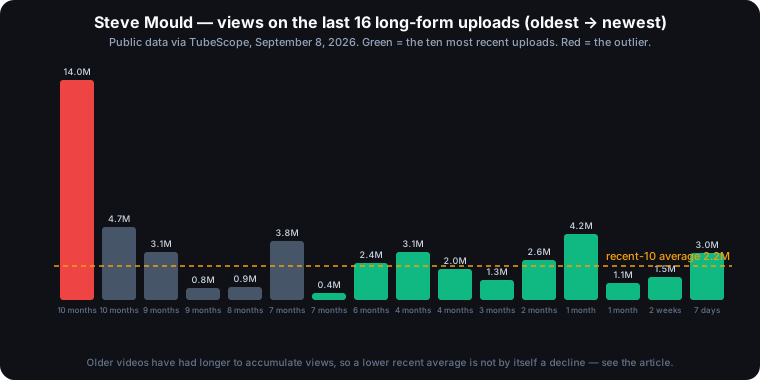
Three numbers matter more than the grade. First, views per subscriber: the recent uploads average 60% of the subscriber count. For a channel this size, 10–20% is normal and 30% is excellent; 60% means almost the whole audience shows up for every video, which is the single most valuable thing about this channel and the hardest to copy. Second, the median of the last 30 uploads is 1,650,000 views — a floor, not a ceiling, and a remarkably high one. Third, the titles: The Arm Spin That Stops a Fall, A New Type of Levitation, The Liquid Hammer Toy You Can't Buy. Every one names a physical object and makes a surprising claim about it in under ten words. That pattern is the channel's real format, and it is copyable.
Minutes 4–6: hidden gems
Run the channel through Hidden Gems, which finds videos with low lifetime views that are currently earning more views per day than the channel's average — the back catalogue quietly waking up.
For Steve Mould the result is zero, and that is a finding. Every video gets its audience at launch, from subscribers and suggested traffic, and then settles. Nothing in the catalogue is being resurfaced by search months later. For a competitor, that tells you where they are not: there is no evergreen search tail to compete with, so a science channel built on searchable explainers — "why does X happen" — would be fishing in water this channel has left alone. For your own channel, a zero here means the same thing in reverse: your growth is entirely launch-driven, and search is an unexploited lever.
Minutes 6–8: put them next to someone
Open Compare and set the channel against a peer — for a science channel, Veritasium, Physics Girl, or your own channel. The verdict weighs the present over the past, so watch three things: whose recent uploads pull a larger share of their subscribers, who uploads more consistently, and whose catalogue works harder per video. A channel can lose on subscribers and win on all three, and that is the channel to learn from. If you are comparing against yourself, the gap on views-per-subscriber is usually the honest measure of how far you have to go.
Minutes 8–10: what it earns
Finally, the Money Calculator. Two uploads a month at the recent average is about 4.3M monthly views. In the Science niche, at a typical advertiser CPM of $6 and YouTube's 55% creator share, that is roughly