In 2012, a repair shop quoted a young Utah phone-store employee
,000 to fix his Jeep. He fixed it himself for $80, filmed the process on his phone, and put it on YouTube. Fourteen years later, Zack Nelson — JerryRigEverything — has 10 million subscribers and over 3 billion views, invented the durability-test format the entire phone industry now designs against, co-owns a wheelchair company, and is a plaintiff in a multimillion-dollar federal lawsuit. This is the full story, compiled from public sources — every claim linked, every estimate labeled.
Fast facts
Real name: Zack Nelson, born June 29, 1988 (age 38) — a Utah native
Channel: JerryRigEverything, launched 2012 — 10,000,000 subscribers and 3.03 billion views as measured live by our tracker (August 31, 2026)
Known for: smartphone durability tests — "scratches at a level 6, with deeper grooves at a level 7" — and the line "glass is glass, and glass breaks"
Wife: Cambry Kaylor Nelson, married August 31, 2019 — seven years ago today
Companies: the JerryRigEverything channel business; Not A Wheelchair (co-founded 2020, Spanish Fork, Utah); the dbrand "Teardown" product line partnership
Before YouTube: construction sites and a phone store
Nelson's background is hands-on, not Silicon Valley: he worked construction in high school and built computers on the side, then spent years behind the counter of a cell phone carrier store — 40 hours a week — while filming videos on nights and weekends, according to a 2019 East Idaho News profile. The early numbers were brutal: his first 100 videos earned about 2,000 subscribers, and the channel ran two full years without making a cent. His stated goal at the time, per a July 2026 Utah Business feature, was to earn ten cents a day from ads.
The turning point was involuntary. The phone store closed, leaving him four months of severance pay. He gave YouTube those four months as a full-time experiment — and within them, the channel became viable. His summary of self-employment, from the same profile: "You can choose your own hours. You can — as long as it's all of them."
The format that made phone makers nervous
Nelson's signature is the durability test: Mohs-hardness picks scratched across the screen, a lighter held to the display, and the two-handed bend test that famously snaps weak phones in half. It sounds simple; it became an institution. Manufacturers now anticipate the JerryRig bend test the way carmakers anticipate crash ratings, and his teardowns — disassembling devices "by any force necessary," as Wikipedia puts it — regularly surface design decisions brands would rather not discuss.
That willingness to test marketing claims literally has made news more than once. In 2024 he shot at a Tesla Cybertruck to test its bulletproof marketing (it stopped handgun rounds; faster rounds penetrated), and in March 2025 his frame-strength testing concluded the truck's design was weaker than traditional steel framing. The fallout was expensive: per Wikipedia's sourced timeline, a sponsor backed out of a Cybertruck video over the association, Nelson publicly clashed with Elon Musk in February 2025, and by March 2025 he had stripped his logo off the truck and moved to sell it. Testing claims, whatever they cost — that's been the brand since the first scratch test.
Cambry, and the video that changed the channel's direction
The most consequential video on the channel isn't a phone test. Cambry Kaylor was a champion equestrian vaulter who was paralyzed at 18 in a training accident. While they were dating, Nelson welded two e-bikes together with a seat in the middle to build her an off-road wheelchair — the video of it reached over 12 million views on Facebook and millions more on YouTube. They married on August 31, 2019; it is widely reported that his wedding ring was machined from the titanium of Cambry's first wheelchair. Cambry is now a creator in her own right and a co-founder of their company, and the channel's engineering projects increasingly orbit accessibility — including the home elevator and adaptive builds documented on their channels.
Not A Wheelchair: the anti-startup startup
In 2020 the couple turned that one-off build into a company: Not A Wheelchair, based in Spanish Fork, Utah. Its product, The Rig — now in a 2.0 version with better suspension and an 18 mph top speed — is a four-wheeled, e-bike-parts off-road chair designed to undercut a market where off-road wheelchairs run over
0,000. The Utah Business feature lays out an unusual structure: no venture capital at all — the company is funded entirely by YouTube earnings, marketing is free because the channel is the ad, and Nelson says competitors spend 20-50% of their budgets on the advertising he skips. His sharpest quote is about the industry he's undercutting: "When someone needs a product to survive, you can charge whatever you want."
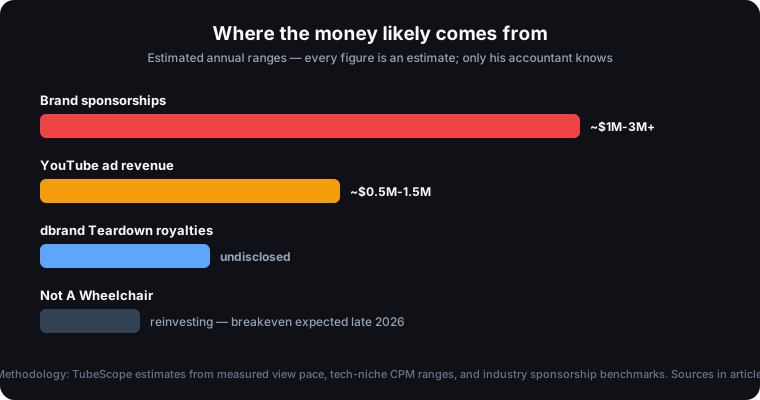
And the honest number that most net-worth articles miss: Not A Wheelchair is not yet profitable. Per the same feature, the company expects to break even in late 2026 or early 2027. Right now it consumes YouTube money rather than adding to it — a deliberate choice to keep prices down, with a possible employee-owned structure ahead.
The Teardown skins and the Casetify lawsuit
Nelson's other business line is his partnership with accessory maker dbrand: Teardown skins and cases, which print a precise X-ray-style image of each device's internals on its back. In November 2023, dbrand and Nelson sued rival Casetify, alleging its "Inside Out" line was copied directly from Teardown images — the evidence included Easter eggs deliberately hidden in the originals (JerryRig catchphrases, dbrand's founding date) that showed up in Casetify's products, as Tubefilter and Engadget reported. Casetify denied wrongdoing and pulled the accused designs. The case — Dbrand Inc. v. Casetagram Ltd., N.D. Illinois — was still working through discovery as of the most recent public docket activity, with no publicly reported settlement or judgment.
So what does he actually earn?
Our estimates, our methodology — and clearly labeled as estimates. Nobody outside his accounting knows the real numbers.
What we measured ourselves: our tracker recorded the channel gaining roughly 1.7 million views in a single 14-hour window this weekend — a pace in the millions of views per day, though a short window can catch a hot streak, and channel totals include Shorts, which pay far less than long-form.
Ad revenue (estimate): applying our Money Calculator methodology — tech-niche CPMs of $4-14, YouTube's ~45% cut, mixed worldwide audience — a channel with his long-form viewership plausibly earns $500K to
.5M per year from ads alone.
Sponsorships (estimate, and likely the bigger number): dedicated tech-channel integrations are commonly benchmarked around
5-50 per thousand views. Nelson's videos routinely clear one to three million views, which prices a single integration in the tens of thousands of dollars — across a year of sponsored videos,
M-3M+ is a defensible range. His dbrand Teardown royalties are entirely undisclosed but represent a mature, years-old product line.
00-135K per year — figures generated by formulas that ignore sponsorships entirely. The truth: after 14 years of seven-figure revenue, minus a self-funded manufacturing company that hasn't hit breakeven, a net worth anywhere in the high single digit to low tens of millions is plausible — and any site quoting an exact figure is guessing.
The rest of the empire
The electric Humvee — a military Humvee converted to electric power using Tesla components, documented across a multi-year build series.
The bunker — an underground backyard bunker build, documented on the channel.
Philanthropy — in 2022 the channel raised funds to build a library in Kenya, per Wikipedia's sourced timeline.
What his story teaches about YouTube as a business
Three lessons stand out. Consistency before results: 100 videos for 2,000 subscribers would end most channels; he kept going for two unmonetized years. Own a format, not just an audience: the durability test is intellectual property in all but name — it made him the reference point an entire industry responds to. And the channel as leverage: YouTube money funds a wheelchair company that spends nothing on ads, gets its R&D from comments, and answers to no investors. Watch his numbers move on his live counter, see the full picture on his channel analytics page, or race him against another tech creator in a Sub Battle.
This profile was compiled from the public sources linked throughout. All income and net-worth figures are estimates — clearly labeled, with methodology shown — because no outside party knows a creator's real finances. Corrections: support@tube-scope.com.
Frequently asked questions
What is JerryRigEverything's net worth?
Nobody outside his accounting knows. Aggregator sites list figures from $5 million to $8 million, but they rely on ad-revenue formulas that ignore sponsorships — likely his largest income stream. Given 14 years of estimated seven-figure annual revenue, offset by self-funding a wheelchair company that expects breakeven in late 2026, a range from the high single-digit millions to the low tens of millions is plausible. Any exact figure you read is a guess.
How much does JerryRigEverything make per year?
Our estimate, with methodology shown in the article: roughly $500K-1.5M per year from YouTube ads, plus
M-3M or more from brand sponsorships, plus undisclosed royalties from the dbrand Teardown product line. His company Not A Wheelchair currently consumes rather than adds income — it is deliberately unprofitable until an expected breakeven in late 2026 or early 2027.
Who is JerryRigEverything's wife?
Cambry Kaylor Nelson, a former champion equestrian vaulter who was paralyzed at 18 in a training accident. They married on August 31, 2019, and co-founded Not A Wheelchair, which builds affordable off-road electric wheelchairs — a company that began with Zack welding two e-bikes together to build her one.
What was the JerryRigEverything Casetify lawsuit about?
In November 2023, Zack Nelson and dbrand sued Casetify, alleging its Inside Out cases copied their Teardown designs — proven, they argued, by hidden Easter eggs from the originals appearing in Casetify's products. Casetify denied wrongdoing and pulled the designs; the federal case in the Northern District of Illinois had no publicly reported settlement or judgment as of the most recent docket activity.
How did JerryRigEverything get started?
In 2012, a shop quoted him
,000 for a Jeep repair he then did himself for $80 — and filmed. He worked 40-hour weeks at a phone store while uploading for two unmonetized years, reaching only 2,000 subscribers after 100 videos. When the store closed, he used four months of severance pay to go full-time, and the channel became viable within those four months.