In September 2024 the man who had spent fifteen years telling twenty million people what not to buy launched a wallpaper app that cost $49.99 a year. The internet noticed. Within days Marques Brownlee had cut the price to
a month and admitted his team had failed on the price front; fifteen months later Panels shut down. It is the most instructive episode in a career otherwise defined by getting things right — and the reason a profile of MKBHD is really a profile of what a reputation is worth.
Fast facts
Real name: Marques Keith Brownlee, born December 3, 1993, in Maplewood Township, New Jersey (Wikipedia)
Education: Columbia High School (2011); BS in business and information technology, Stevens Institute of Technology, May 2015; honorary Doctor of Business Administration from Stevens, May 2024 (Fast Company)
Main channel:@mkbhd — 21.2M subscribers and about 5.57 billion views on September 8, 2026, measured by our tracker (watch the live count)
Other channels: The Studio, Auto Focus, Waveform (WVFRM), Waveform Clips, MKBHD Shorts
Businesses and roles: Waveform podcast (Vox Media Podcast Network); board member, equity investor, and chief creative partner at Ridge; stakes in Opal and Riverside.FM (Fortune)
Also: professional ultimate frisbee player — world club champion with New York PoNY in 2022, gold at the 2025 World Games (Wikipedia)
A bedroom, a laptop, and things he already owned
Brownlee joined YouTube in March 2008 and uploaded his first videos in January 2009, as a high-school student, reviewing products he already had — software, then hardware (Wikipedia). The grind was long: it took until January 2012 for Engadget to feature one of his reviews, a piece on a cloud-storage service, and until August 2013 for the line that changed his trajectory, when Google's Vic Gundotra called him “the best technology reviewer on the planet right now”. A scratch test of the LG G Flex went viral that November; the channel passed one million subscribers in February 2014, while he was still an undergraduate; and a July 2014 video testing the rumoured sapphire display of the iPhone 6 became one of the defining tech videos of the decade.
Ten million subscribers arrived on December 18, 2019. Twenty million came in the mid-2020s. On the day this was written the channel stood at 21.2 million and was adding roughly 1,536,888 views a day, measured across our nine days of daily snapshots to September 8, 2026 — a healthy pace for a channel this mature, driven by a steady cadence of 5 long-form uploads in the last 30 days averaging 4,260,000 views each.
The format: calm, clean, and willing to say no
What Brownlee built is not a personality channel; it is a standard. The videos are shot like commercials — matte black, red accents, long lenses — and delivered in a register somewhere between a lecture and a conversation. Two things earned the trust that everything else rests on. He never let production quality substitute for a verdict, and the verdicts were sometimes brutal. In early 2024 he called the Fisker Ocean “the worst car I’ve ever reviewed”; that April, a 25-minute review titled The Worst Product I’ve Ever Reviewed… For Now dismantled the $699 Humane AI Pin and drew more than six million views.
The Humane review triggered a debate that says a lot about his position. A commentator called it “almost unethical” to publish such a verdict to eighteen million subscribers; Brownlee’s reply was five words: “We disagree on what my job is.” TechCrunch’s headline was blunter still: don’t blame MKBHD for the fate of Humane and Fisker. Both companies later collapsed for reasons that had nothing to do with a YouTube video, which was rather the point.
The other career
The detail most profiles skip is that Brownlee has been a professional athlete for most of his creator career. He played ultimate frisbee at Stevens, joined the New Jersey Hammerheads of the AUDL in 2013, went on to Garden State Ultimate and the Philadelphia Phoenix, and then the New York Empire, with whom he won league championships in 2019, 2022, and 2023 (Wikipedia). On July 31, 2022 his club side New York PoNY won the WFDF World Ultimate Club Championship, and in 2025 he took a gold medal in the mixed event at the World Games. He has said the two careers feed each other; what is certain is that he has run both at an elite level simultaneously for over a decade.
The businesses
Waveform. The podcast launched in August 2019 with co-hosts Andrew Manganelli and David Imel, joined the Vox Media Podcast Network, and had passed 360 episodes by mid-2026 (Wikipedia). It runs as its own YouTube channel and taped live at SXSW in 2025. Vox does not disclose show-level revenue.
Ridge. On February 22, 2024 Brownlee took his first-ever board seat, at the Los Angeles accessories company Ridge, as board member, equity investor, and chief creative partner (BusinessWire). Ridge, founded in 2013 by Daniel and Paul Kane off a
26,000 Kickstarter, had 75 employees and revenue in the “hundreds of millions” when the deal was announced; the size of his stake was not disclosed, and Ridge declined to say whether he invested cash or received equity. CEO Sean Frank’s stated goal was to make Ridge “synonymous with the MKBHD brand”; Brownlee’s line was “We’re going to be in this for the long haul.” The same Fortune piece noted stakes in the laptop-camera maker Opal and the recording platform Riverside.FM, and an April 2023 sneaker collaboration with Atoms.
Panels. Launched in September 2024 as a wallpaper app at
1.99 a month or $49.99 a year, with an option to watch ads for lower-resolution downloads, Panels was criticised within hours for its price, for in-app ads, for requesting location and cross-app tracking permissions, and for including AI-generated art (Android Police). Brownlee conceded the pricing mistake and cut the subscription to
a month, but the app never recovered. On December 1, 2025 he announced it would shut down on December 31: the development team’s makeup had changed, he could not find collaborators who were the right fit, and he had not been able to turn it into the product he had envisioned. Annual subscribers were refunded and the code was released under an open-source licence in January 2026. Download and subscriber figures were never published.
Controversy timeline
February 2024 — Fisker Ocean review, “the worst car I’ve ever reviewed.” Fisker filed for bankruptcy later that year; commentators debated the review’s role (TechCrunch).
April 2024 — Humane AI Pin review; accusations of an “unethical” verdict; “We disagree on what my job is” (PetaPixel).
September 2024 — Panels launch and pricing backlash; price cut to
November 2024 — A DJI-sponsored action-camera video included a clip of him driving a Lamborghini at 96 mph in a 35 mph zone near a school sign. He removed the clip and apologised: “Absolutely inexcusable and dangerous… That’s a terrible example to set and I’m sorry for it” (NBC News). In December, police body-camera footage of earlier traffic stops circulated (Wikipedia). No further legal outcome has been publicly reported.
December 2025 — Panels shutdown announced; app closed December 31 (MacRumors).
So what does he actually earn?
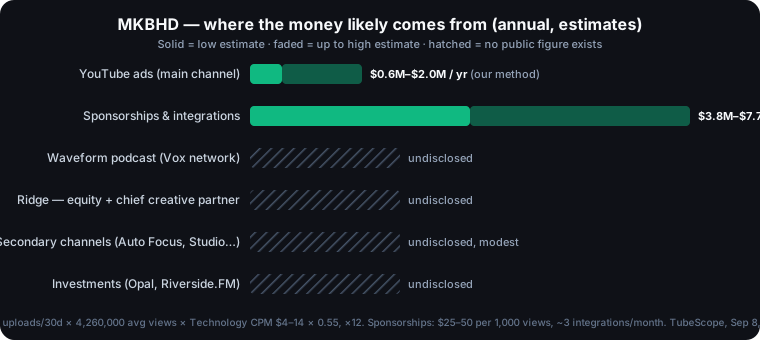
Every solid bar is an estimate with the method shown; every hatched bar is a stream with no public number. Nobody outside his accounting knows the total.
What we can measure. On September 8, 2026 our tracker read 21.2M subscribers and roughly 5.57 billion views, growing by about 1,536,888 views a day over the preceding nine days. The main channel posted 5 long-form videos in the last 30 days averaging 4,260,000 views each, about 12 minutes long. That is a monthly run-rate of roughly 21.3 million views. (Caveat: nine days is a short window and a single big review can swing it.)
Ads, by our method. Using the Technology niche in our Money Calculator — advertiser CPM of $4 to
4, typically $8, and YouTube’s 55% creator share — that run-rate is worth about $93,720 a month from ads, in a range of $46,860 to
64,010, or roughly $0.6M to
.0M a year. His audience skews toward the expensive end (American, adult, buying phones), so the truth likely sits in the upper half.
Sponsorships, by benchmark. Integrations in a video averaging 4,260,000 views are worth, at the common industry benchmark of
5 to $50 per thousand views, about
06,500 to
13,000 each. If roughly three videos a month carry a sponsor, that is $3.8M to $7.7M a year — rough, but it shows why sponsorships, not ads, are the engine. His DJI, Ridge, and phone-maker integrations are the visible part of this.
What nobody publishes. Waveform’s podcast revenue, his Ridge equity and compensation, the Opal and Riverside.FM stakes, and the secondary channels have no disclosed figures. The one dated, credible data point from a serious outlet is Forbes’ estimate of $8.5 million in annual earnings, as cited by Fortune in February 2024 — consistent with the ads-plus-sponsorships arithmetic above.
The net-worth sites, and why they disagree.One site puts his net worth at
0 million; another says
0 million; a third produces a figure from a formula that multiplies views by an assumed rate. They cannot all be right, and none of them shows a method that accounts for sponsorships, equity, or a podcast network deal — which for a creator of this kind is most of the money. Read them as guesses. Our own honest framing: a decade-plus of eight-figure annual earnings, an undisclosed stake in a company doing hundreds of millions in revenue, and no public liabilities suggests a net worth comfortably in the tens of millions, with the exact figure unknowable from outside.
Recognition
Shorty Awards Creator of the Decade in April 2018; Forbes 30 Under 30 in December 2020; the TIME100 list of the most influential people in AI in September 2024; an honorary doctorate from his alma mater in May 2024; and, in May 2025, a spot in the PGA Tour’s Creator Classic (Wikipedia). The honorary degree prompted the internet’s best joke about him: MKBHD became MKPhD.
Lessons for creators
Trust is the asset; everything else is a product built on it. Ridge did not buy a reviewer; it bought fifteen years of verdicts people believed. Panels showed what happens when a product asks the audience to pay for the brand rather than for value.
Consistency beats virality. Five years to a million subscribers, five more to ten million. The sapphire video was a spike; the cadence was the channel.
Say the honest thing, then hold the line. “We disagree on what my job is” is a five-word business model.
Compiled from public sources linked above and from TubeScope’s own tracker data on September 8, 2026. All income and net-worth figures are estimates built from public data and stated methods; nobody outside Marques Brownlee’s accounting knows the real numbers. Corrections: support@tube-scope.com.
Frequently asked questions
What is MKBHD's net worth?
No credible public figure exists. Net-worth sites claim anywhere from
0 million to
0 million using formulas that ignore sponsorships, his undisclosed Ridge equity, and podcast income. Based on a decade of eight-figure annual earnings (Forbes estimated $8.5 million a year in 2024) and an equity stake in a company with hundreds of millions in revenue, a net worth in the tens of millions is the honest framing.
How much does MKBHD make a year?
By our public-data method, the main channel earns roughly $0.6M to
.0M a year from ads, and sponsorships at his view counts plausibly add several million more. Forbes estimated $8.5 million in annual earnings in early 2024. Podcast, Ridge, and investment income are undisclosed.
How did MKBHD start?
He uploaded his first videos in January 2009 as a New Jersey high-school student, reviewing products he already owned. It took until 2014 to reach one million subscribers and until December 2019 to reach ten million — a slow, consistent climb rather than a viral break.
What happened with the Panels app?
Launched in September 2024 at
1.99 a month or $49.99 a year, Panels was criticised for its price, in-app ads, and tracking permissions. Brownlee admitted the pricing mistake and cut it to
a month, but the app never recovered and shut down on December 31, 2025, with annual subscribers refunded and the code open-sourced.
What was the MKBHD speeding controversy?
In November 2024 a sponsored video briefly showed him driving 96 mph in a 35 mph zone. He removed the clip and apologised publicly, calling it inexcusable and dangerous. Police body-camera footage of earlier traffic stops circulated the following month. No further legal outcome has been publicly reported.