Veritasium (Derek Muller) Net Worth 2026: The Science Channel That Was Sold Without Anyone Noticing (Businesses, Income)

By TubeScope Editorial Team · 2026-09-08 · 11 min read
The Creator File: Veritasium — channel avatar with live subscriber and view counts
Channel avatar © Derek Muller / Veritasium, via the public YouTube channel @veritasium · card composition and live stats by TubeScope

On Christmas Day 2025 the most-watched science channel on YouTube published a video asking, in its own title, whether its host was retiring. Derek Muller's answer was a disclosure most of his 21.2M subscribers had never heard: for two and a half years, Veritasium had been majority-owned by an investment firm, its videos now made by a team of more than thirty, and he would be around less. The reaction was muted, because the videos had never been better — the channel's biggest hit ever landed two weeks later. That is the whole story of Veritasium in one paragraph: a one-man channel that became a studio without anyone noticing, because the product got better.

Fast facts

  • Real name: Derek Alexander Muller, born November 9, 1982, in Traralgon, Australia; raised in Vancouver, Canada, from the age of eighteen months (Wikipedia)
  • Education: BASc in Engineering Physics, Queen's University, 2004; PhD in physics education research, University of Sydney, 2008 — thesis Designing Effective Multimedia for Physics Education (University of Sydney)
  • Channel: @veritasium — 21.2M subscribers and 4,524,513,948 views on September 8, 2026, measured by our tracker (watch the live count); launched January 2011
  • Ownership: majority owned by Electrify Video Partners since April 21, 2023; Muller retains a stake and became a shareholder in Electrify (Electrify)
  • Team: more than thirty writers, directors, researchers, animators, and editors (Tubefilter)
  • Other: Snatoms, a magnetic molecular modelling kit; documentaries for SBS and CuriosityStream; correspondent on Netflix's Bill Nye Saves the World

A PhD about why good explanations fail

The format was a research finding before it was a channel. For his doctorate, Muller tested how first-year physics students learned from videos and found something uncomfortable: students who watched a clear, polished explanation felt they understood it and learned almost nothing, while students shown a version in which someone stumbles through the wrong idea first improved significantly. “Some level of discomfort seems to be essential,” he told Scientific American. “That's when learning can really take place.”

He spent his PhD years teaching at a tutoring company, became its full-time head of science after 2008, and quit at the end of 2010 (Wikipedia). Veritasium — Latin veritas plus the suffix of an element — launched in January 2011 while he was still working fifteen hours a week. The signature move was in the first videos and never left: stop people in the street, let them state the misconception in their own words, then take it apart. A 2011 video on the distance to the moon was picked up by CBS; a TEDx talk followed in 2012; one million subscribers came in 2013 and ten million in 2021 (Scientific American). His stated ambition has not changed: “to be the good science teacher for those who never had a good science teacher.”

The videos that defined it

How An Infinite Hotel Ran Out Of Room (2021) sits at over 37 million views; Why No One Has Measured The Speed Of Light at 24 million. The bet video — A Physics Professor Bet Me

0,000 I'm Wrong — is at nearly 25 million, and the story behind it is the channel in miniature. In May 2021 Muller rode Blackbird, a wind-powered cart, faster than the wind that was pushing it. UCLA physicist Alexander Kusenko emailed within a week to say that was impossible, and a
0,000 wager was signed with Bill Nye, Neil deGrasse Tyson, and Sean Carroll as witnesses. Three weeks later Kusenko conceded and paid; Muller put the money into science-communication prizes and admitted the resolution “was not as clean as I'd hoped.”

The channel's turn toward investigation came with How One Company Secretly Poisoned The Planet (May 2025), an hour on PFAS chemicals that drew nearly three million views in its first day and more first-day watch time than any Veritasium video before it, released the same day the EPA announced it was rolling back PFAS limits (Scientific American). It won the 2025 AAAS Kavli Gold Award for in-depth video reporting and a 2026 Webby. Then, in January 2026, The Ridiculous Engineering Of The World's Most Important Machine, on the Dutch lithography company ASML, became the channel's best-performing video ever with 11.3 million views in seven days.

The business

Snatoms. In November 2015 Muller put a magnetic molecule-building kit on Kickstarter with a $42,000 goal; it funded in about an hour and closed at $519,852 from 6,581 backers. The company says it has sold 10,000 units and moved to Amazon. A modest business, but an early sign he thought about products.

Electrify. On April 21, 2023 Electrify Video Partners, a London firm that buys stakes in YouTube channels, completed a majority investment in Veritasium, which then had thirteen million subscribers. The price was not disclosed; Electrify had said its deals run from several hundred thousand dollars to many millions. Muller kept an ownership interest, took shares in Electrify, and said the point was to “hand off a lot of those things and focus on my core passion of making great videos.” A figure of 80% appears in a 2026 Forbes headline we could not access and is unverified. What is verified is the effect: production costs quadrupled, subscribers rose by about half, videos now take two to six months to make, and the channel's own website is now copyrighted to Electrify US LLC. Muller's own summary: “The real way we've been able to grow is by adding more people.”

Sponsorships. Integrations run per video — KiwiCo, Brilliant, and, once, Waymo — alongside Patreon.

Controversy timeline

  • May–June 2021 — The Blackbird bet, resolved in his favour as above.
  • July–October 2021Why You Should Want Driverless Cars On Roads Now, which disclosed that Waymo sponsored the video and provided access. In October the creator Tom Nicholas published a critique calling it propaganda, alleging cherry-picked crash statistics and weak analogies (discussion); Muller replied that he welcomed criticism but was disappointed Nicholas had not fixed the factual errors flagged to him by email beforehand.
  • November 2021 – May 2022The Big Misconception About Electricity drew technical rebuttals from ElectroBOOM, EEVblog, and AlphaPhoenix, who bought a kilometre of wire to test it. Muller's follow-up, How Electricity Actually Works, credits all three — a public correction cycle rather than a feud.

No litigation involving Muller or the channel appears in any source we could verify.

So what does he actually earn?

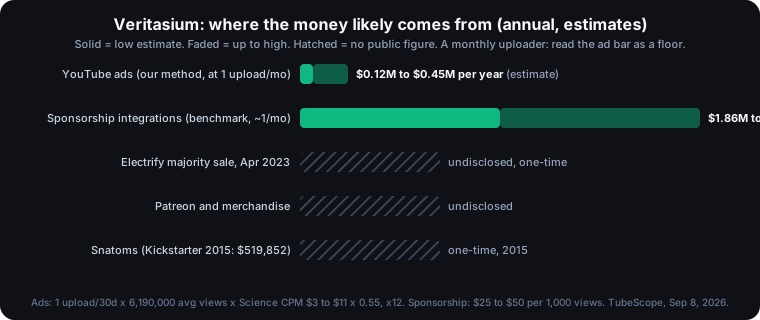
Estimated income streams for Veritasium: YouTube ads by our method, sponsorships by benchmark, with the Electrify sale, Patreon, and merchandise undisclosed
The largest single event in the channel's finances — the 2023 sale — has no public number. Everything else is an estimate with the method shown.

What we can measure. On September 8, 2026 our tracker read 21.2M subscribers and 4,524,513,948 views, adding about 2,363,945 views a day across the preceding 9 days of snapshots. The channel posted 1 long-form video in the last 30 days and 6 in the last 90 — the last ten averaged 6,190,000 views and about 30 minutes. This is the low-frequency, high-effort pattern our calculator handles worst, so the figures below are deliberately conservative.

Ads, by our method. In the Science niche — advertiser CPM of $3 to

1, typically $6, and YouTube's 55% creator share — one upload a month at that view count is worth about
0,427 a month, in a range of
0,213 to $37,449. Tubefilter's figure of roughly 75 million views a month across the catalogue implies the real ad total is several times higher, since old Veritasium videos keep earning; read our number as the floor for new work alone.

Sponsorships, by benchmark. An integration in a video averaging 6,190,000 views is worth roughly

54,750 to $309,500 at the common
5–50-per-thousand benchmark — and an educated adult audience commands the top of that range.

What nobody publishes. The Electrify price, Muller's remaining stake, Patreon, and merchandise. Since 2023 the more accurate question is not what Derek Muller earns but what Veritasium earns as a company, and only Electrify knows.

The net-worth sites, and why they disagree. One claims

5 million and, without a source, that Patreon alone brings
.5 million a year; another says $9.1 million from a formula multiplying daily views by an assumed CPM; a third says $5 million and admits its figures are generated algorithmically. None of them mentions that a majority of the channel was sold in 2023 — the single largest financial event in its history. Our honest framing: a decade of a top-tier channel's income plus the proceeds of a majority sale to a funded acquirer puts Muller's net worth plausibly in the low tens of millions, with the exact figure unknowable from outside.

Recognition

A 2016 Eureka Prize for science journalism for the documentary Uranium — Twisting the Dragon's Tail; a 2017 Streamy for science and education; the 2025 AAAS Kavli Gold Award; and two 2026 Webby People's Voice awards, one for the PFAS film and one for a collaboration with Tom Brady on the physics of football (Webby Awards). His university named its 2024 profile of him “The element of truth.”

Lessons for creators

  • Build the format on a real insight. Veritasium's street interviews are a peer-reviewed finding about how people learn, not a stylistic choice. Formats grounded in something true survive fifteen years.
  • Selling control can make the work better. The channel's best video ever came after its founder stepped back. What he sold was administration; what he kept was the part only he could do.
  • Correct in public. The electricity video's critics ended up credited in the sequel. That is how a channel earns the standing to say, in Muller's words, that “the unvarnished truth of the channel: it's trying to promote the increase of rationality and critical thinking.”

Compiled from public sources linked above and from TubeScope's own tracker data on September 8, 2026. All income and net-worth figures are estimates built from public data and stated methods; the Electrify transaction value is undisclosed, and nobody outside the company's accounting knows the real numbers. Corrections: support@tube-scope.com.

Frequently asked questions

What is Veritasium's net worth?

No verified figure exists. Sites claim $5 million to

5 million using formulas that ignore the 2023 majority sale of the channel to Electrify Video Partners — the largest financial event in its history, whose price was never disclosed. A decade of top-tier channel income plus the proceeds of that sale plausibly puts Derek Muller in the low tens of millions; the exact number is unknowable from outside.

Who owns Veritasium?

Electrify Video Partners, a London firm that invests in YouTube channels, completed a majority investment on April 21, 2023. Derek Muller retains an ownership interest and became a shareholder in Electrify. A widely quoted 80% figure comes from a 2026 Forbes headline we could not verify.

How much does Veritasium make per video?

By our public-data method, a video averaging 6,190,000 views earns roughly

0,213 to $37,449 from ads in the Science niche, and a sponsorship integration at that view count is worth about
54,750 to $309,500 by industry benchmark. The back catalogue earns on top of that, and the team of thirty-plus is paid from all of it.

Is Derek Muller retiring?

No. In December 2025 he said he would appear less often and disclosed the Electrify deal, but the channel continues with a team of more than thirty and published its most-watched video ever in January 2026.

What was the Veritasium
0,000 bet?

In 2021 UCLA physicist Alexander Kusenko bet Muller

0,000 that a wind-powered vehicle could not travel faster than the wind pushing it, with Bill Nye, Neil deGrasse Tyson, and Sean Carroll as witnesses. Kusenko conceded within about three weeks and paid; Muller put the money toward science-communication prizes.

Try it yourself: Veritasium channel analytics · Veritasium live subscriber count · Money Calculator

← All articles