How to Write YouTube Titles That Get Clicks (With Examples)
By TubeScope Editorial Team · 2026-06-16 · 8 min read
Your title has one job: earn the click. The metric that measures it is click-through rate (CTR) — the share of people who click after seeing your thumbnail and title — and improving it is the cheapest growth lever you have, because a better title multiplies the views you get from the same impressions. Below are the patterns that reliably raise CTR, the psychology behind them, and before/after rewrites you can copy.
Why titles matter more than almost anything
Look at what changes when only the title's CTR moves, on a video that earns 100,000 impressions:
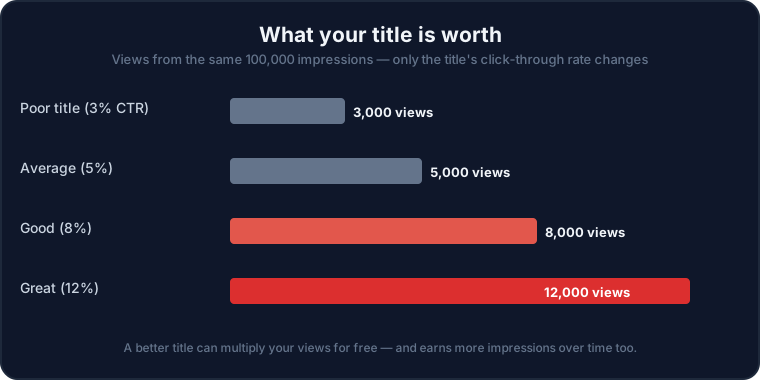
And it compounds: a higher CTR tells YouTube the video is worth recommending, so it earns more impressions too. That's why fixing weak titles is usually the fastest way to grow — you're not making more content, you're getting more from the content you already have.
What makes a title get clicked
Strong titles almost always combine a few of these ingredients:
- A curiosity gap — open a question the viewer needs answered, without giving away the ending.
- Specificity and numbers — "7 edits" beats "some edits"; concrete details feel more credible and clickable.
- A clear payoff — the viewer should instantly know what they get for watching.
- Stakes or emotion — surprise, ambition, risk, or a strong result raises interest.
- Front-loaded keywords — put the important words first so they survive truncation and help search.
- Brevity — aim for roughly 60 characters or fewer so the title isn't cut off on mobile or in suggested feeds.
Title patterns that work
The number / list
"7 YouTube Title Tricks That Doubled My Clicks." Numbers promise structure and a finite, scannable payoff.
The how-to / outcome
"How to Edit Faster (Without Losing Quality)." Names the result and the objection it removes.
The curiosity gap
"I Stopped Doing This — and My Views Tripled." Withholds the key detail so the click is the only way to resolve it.
The contrarian / myth-buster
"Why 'Post Every Day' Is Hurting Your Channel." Challenging common advice creates instant tension.
The first-person test
"I Tried MrBeast's Thumbnail Strategy for 30 Days." First-person experiments feel authentic and lower the viewer's skepticism.
Before and after
Same videos, stronger packaging:
- ❌ "My editing process" → ✅ "The 5-Step Editing Process That Saves Me 10 Hours a Week"
- ❌ "Channel update + new camera" → ✅ "I Switched Cameras — Here's What Nobody Tells You"
- ❌ "Tips for small YouTubers" → ✅ "7 Things I Wish I Knew at 0 Subscribers"
- ❌ "How much I made on YouTube" → ✅ "What 1,000,000 Views Actually Paid Me"
Notice the pattern: each rewrite adds a number or specific, a clear payoff, and a small curiosity gap — without lying about the content.
Mistakes that quietly cost you clicks
- Misleading clickbait. A title that over-promises gets the click but tanks retention when the video doesn't deliver — and weak retention is worse for reach than a low CTR. Tease, then pay it off.
- Vagueness. "My thoughts on this" tells the viewer nothing. Be concrete.
- Keyword stuffing. Cramming search terms reads like spam and lowers clicks. Write for a human first.
- Too long. Past ~60 characters your title gets truncated and the payoff disappears.
- Title fighting the thumbnail. The title and thumbnail should say two halves of one idea, not repeat or contradict each other.
How to test and improve your titles
Don't guess — generate options and compare. Paste your video into the free AI Title Rewriter to get multiple stronger variants in different styles, then check your tags and SEO so the title supports search as well as clicks. If your impressions are healthy but views are low, packaging is the bottleneck — confirm it with a channel audit, and browse Trending to see which title styles are winning in your niche right now.
The quick takeaways
- CTR is the lever: a better title multiplies views from the same impressions and earns more impressions over time.
- Combine a curiosity gap, a specific number, and a clear payoff — in under ~60 characters.
- Tease, then deliver. Misleading titles kill retention, which hurts more than low CTR.
- Generate variants and test instead of guessing.
Rewrite your next title free with the AI Title Rewriter, or run a channel audit to see whether your packaging is holding you back.
Frequently asked questions
What is a good click-through rate (CTR) on YouTube?
Most channels average around 4–6% CTR, though it varies by niche and traffic source. Above 8% is strong and above 10% is excellent. Don't chase a single number — compare each video to your own typical CTR to see if a title is over- or under-performing.
How long should a YouTube title be?
Aim for about 60 characters or fewer so the title isn't truncated on mobile, in search, or in suggested feeds. Front-load the most important and clickable words so they survive even if the end is cut off.
Do titles affect SEO or just clicks?
Both. Titles help YouTube understand what your video is about (search and suggested relevance) and they drive click-through rate. Write for a human first — a title people actually click will outperform a keyword-stuffed one.
Is clickbait bad for my channel?
Curiosity is good; deception is not. A title that over-promises earns the click but kills audience retention when the video doesn't deliver, and poor retention hurts reach more than a low CTR. Tease the payoff, then actually deliver it.
How do I know if my title is the problem?
Check your analytics: if a video gets healthy impressions but a low click-through rate, the packaging (title and thumbnail) is the bottleneck. If CTR is fine but viewers leave quickly, the content or hook is the issue instead. A channel audit makes this easy to spot.
Try it yourself: AI Title Rewriter · Tags & SEO Tool · Channel Audit