How Much Do YouTube Shorts Pay? (Real Numbers)
By TubeScope Editorial Team · 2026-08-30 · 7 min read
YouTube Shorts typically pay creators around $0.05–$0.20 per 1,000 views — that's roughly $50–
By TubeScope Editorial Team · 2026-08-30 · 7 min read
YouTube Shorts typically pay creators around $0.05–$0.20 per 1,000 views — that's roughly $50–
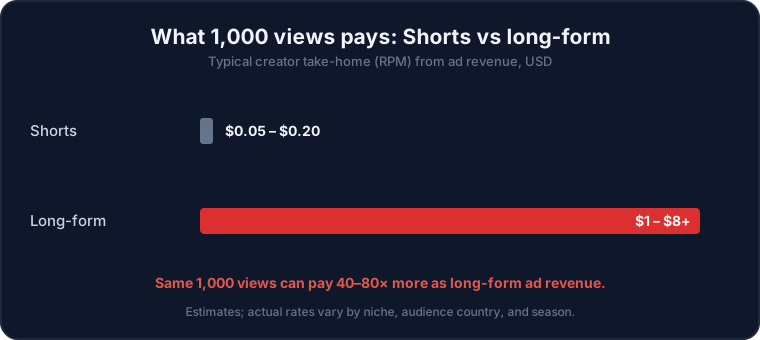
This is why a channel can rack up millions of Shorts views and earn less than a channel getting a fraction of those views on regular videos — something to remember whenever you compare channels by raw view counts.
Shorts aren't monetized like regular videos, where ads run on your video and you get a direct share. Instead:
The practical effect: your Shorts income depends not just on your views, but on the whole platform's ad revenue and everyone else's views that month — which is why Shorts RPM drifts month to month no matter what you do.
Shorts ad revenue requires joining the YouTube Partner Program: 1,000 subscribers plus either 10 million public Shorts views in 90 days or 4,000 long-form watch hours in 12 months. (Shorts views do not count toward the 4,000 watch hours — they're separate tracks.) Full details in our guide on how many subscribers you need to make money.
Model your own numbers with the free Money Calculator — and remember its long-form estimates don't apply to Shorts-heavy channels.
Often yes — just not for the ad money. Shorts are the strongest discovery engine on YouTube right now:
The winning pattern for most channels: Shorts for reach, long-form for revenue. Treat Shorts RPM as a bonus, not a business model.
Typically around $0.05–$0.20 per 1,000 Shorts views, depending on niche, audience country, and the month's Creator Pool. That works out to roughly $50–
Usually somewhere between $50 and 00 from the Shorts revenue pool. The same million views on long-form video commonly earns
Shorts are monetized from a shared pool of feed ads divided across all creators by view share, with a music-licensing cut and a 45% creator share. Long-form runs ads directly on your video with a 55% share, and advertisers pay far more per viewer there.
No. Shorts have their own track: 1,000 subscribers plus 10 million public Shorts views in 90 days. The 4,000 watch hours path counts long-form watch time only.
Often yes — as a growth engine rather than an income source. Shorts reach non-subscribers at huge scale, feed your long-form audience (where ad rates are much higher), and can earn well through brand deals that bypass the ad pool entirely.
Try it yourself: Money Calculator · Channel Audit · Trending Videos