Why Is My YouTube Channel Not Growing? 7 Checks, in the Order That Finds the Leak
By TubeScope Editorial Team · 2026-09-08 · 8 min read
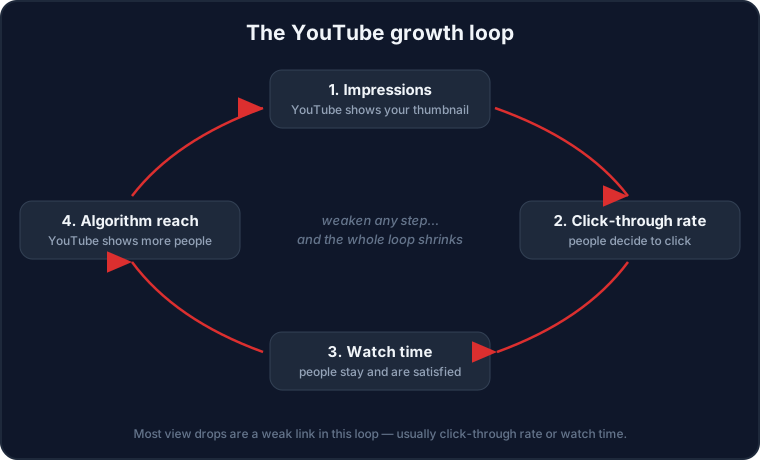
A channel that is not growing is rarely a channel doing everything wrong. It is usually a channel with one leak — and the leak is almost always in the same two places. Here are seven checks, in the order that finds the leak fastest, with the free tool that runs each one. If your views used to be higher and fell, read why views drop instead; this guide is for the channel that has flatlined.
Check 1: are people clicking? (click-through rate)
Open YouTube Studio and look at impressions click-through rate for your last ten videos. Below roughly 3–4% and the loop is leaking at the first controllable stage: YouTube is showing your video, and people are choosing something else. This is a packaging problem, not a content problem, and it is the most common reason a channel stalls. Fix the promise before touching the video: run your title through the Title Rewriter to see five angles side by side, and put your thumbnail next to the videos ranking for your topic in the Thumbnail Tester. If your thumbnail blends into the feed and your title says what the video is instead of why to watch, you have found the leak.
Check 2: are they staying? (retention)
If click-through is healthy but views still stall, look at the retention graph. A cliff in the first thirty seconds means the video does not deliver what the packaging promised, or takes too long to start. A steady slide means pacing. YouTube reads both as a satisfaction signal and stops recommending the video to new viewers. The fix is structural: open with the payoff or the question, cut the preamble, and make every minute earn the next. No tool fixes retention; watching your own video with a stopwatch does.
Check 3: are you consistent? (cadence)
Run your channel through the Channel Audit and read the consistency score. It measures regularity — the same gap between uploads — not volume. Channels that post in bursts and then vanish score low even with a high monthly total, and both the audience and the recommendation system respond to predictability. If the score is low, the fix is choosing a cadence you can hold for six months, even if it is slower than you would like.
Check 4: does your audience show up? (views per subscriber)
Divide your average views on recent videos by your subscriber count. Under 5% means most of the people who subscribed are not watching — the audience you built is not the audience for what you make now, or you drifted topics. The Compare tool shows this ratio against a channel you admire, and the gap is usually humbling and useful. The fix is either to return to what the audience subscribed for, or to accept that you are rebuilding an audience and stop treating the subscriber count as a floor.
Check 5: is there demand? (topic)
Some channels do everything right for a topic nobody searches or browses for. Check your category's chart on Trending for formats that recur, and use the Tags tool to see how people actually phrase searches around your subject. If the phrases you would use never appear, you may be making videos for a question nobody is asking — which is a positioning problem, not an effort problem.
Check 6: is your catalogue working? (hidden gems)
Run Hidden Gems on your own channel. If it finds videos quietly gaining views months after upload, you have search or suggested traffic working for you — refresh those titles and thumbnails, link to them, and make sequels. If it finds nothing, every video gets its audience at launch and then dies. That means your growth is entirely launch-driven, and the fix is to add searchable, evergreen videos to the mix so the catalogue compounds instead of resetting to zero with each upload.
Check 7: are you confusing the system? (format mix)
A channel that alternates Shorts and long-form without a plan can end up with two audiences that do not overlap — Shorts viewers who never watch the long videos and long-form subscribers who ignore the Shorts. Neither format is wrong, but the recommendation system learns who watches what, and mixed signals make it cautious. If your Shorts are a discovery tool, make them point at the long-form work; if they are a separate strategy, consider a separate channel.
What not to do
- Do not chase upload time. It matters far less than consistency. Our guide on upload timing explains why.
- Do not buy subscribers or views. They destroy views-per-subscriber, which is exactly the ratio that tells YouTube whether to show your videos to more people.
- Do not rebrand every month. A channel that changes name, niche, and style before the audience has learned what it is never gets the chance to be recommended for anything.
Run the seven checks in order and stop at the first one that fails — that is your leak. Most stalled channels find it at check one or two, and fixing it there costs nothing but a better title and a tighter first minute.
Frequently asked questions
Why is my YouTube channel not growing even though I upload consistently?
Consistency keeps the loop running but does not start it. Check click-through rate first: if people are not clicking, YouTube stops showing the video regardless of how regularly you post. Then check early retention. Most stalled channels leak at one of those two stages.
What is a good click-through rate on YouTube?
It varies by surface and niche, but most channels sit between 2% and 10%. Below roughly 3–4% on your recent videos usually means the title and thumbnail are the leak. Compare your videos against each other rather than against a universal number.
Why do my subscribers not watch my videos?
Because subscribing is a one-time decision and watching is a repeated one. If recent videos draw under 5% of your subscriber count, the audience you built is not the audience for what you make now — usually a topic drift. Return to what they subscribed for, or accept that you are rebuilding.
Does posting time affect growth?
Only slightly, through your audience's activity window. Regularity matters far more than the minute. A predictable cadence is one of the few growth levers entirely within your control.
Should I delete old videos that got no views?
Generally no. They rarely hurt, and some may be earning search traffic quietly — run Hidden Gems on your channel to see which. Improve their titles and thumbnails before considering removal.
Try it yourself: Channel Audit · Title Rewriter · Hidden Gems