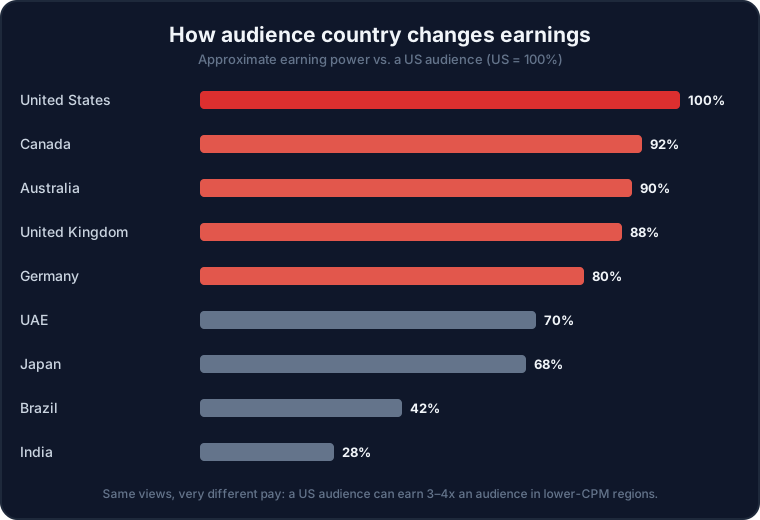
Two channels with identical views can earn wildly different money for one reason: where their viewers live. Advertisers pay several times more to reach viewers in the United States, United Kingdom, Canada, and Australia than viewers in most other markets — so audience geography matters as much as niche. Here are the real relative rates by country, why the gap exists, and what you can actually do with this.
The country pay ladder
Approximate earning power by audience country, relative to a US audience — the same factors our Money Calculator uses.
Reading it in dollars: if a tech channel earns an $8 CPM from US viewers, the same 1,000 views earn roughly $7 from Canadian viewers, $6.40 from British viewers, ~$5.40 from Japanese viewers, ~$3.40 from Brazilian viewers, and ~
.20 from Indian viewers. Multiply across millions of views and geography quietly becomes one of the biggest numbers in your revenue.
Why advertisers pay more for some countries
Purchasing power: advertisers bid more where viewers can spend more on their products.
Advertiser competition: the US/UK/CA/AU ad markets are crowded with bidders, which drives auction prices up.
E-commerce depth: markets where buying online is routine convert better, so their views are worth more.
None of this reflects content quality — it's purely the economics of the ad auction happening behind your videos.
The rough tiers
Tier 1 (highest): United States, United Kingdom, Canada, Australia — the benchmark markets.
Tier 2: Western Europe (Germany, France, Nordics), Japan, South Korea, the Gulf states.
Tier 3: Latin America, Eastern Europe, Southeast Asia.
Tier 4 (volume markets): South Asia, much of MENA and Africa — enormous audiences, low per-view rates.
What you can realistically do about it
Publish in English if your niche allows — it's the passport to Tier-1 audiences.
Pick topics with international demand: tech reviews, finance, tutorials, and "how to" content travel to high-CPM markets; hyper-local content stays local.
Watch your audience mix, not just views: in YouTube Studio (Analytics → Audience), a channel gaining US/UK share is gaining earning power even if total views are flat.
Don't chase tricks: you can't force geography — VPN games and fake targeting violate policy and don't survive. Make content Tier-1 audiences search for instead.
Estimate the effect on your own channel with the Money Calculator — it has an audience-country selector built in. And remember country stacks with niche: the full picture is in how much YouTube pays per 1,000 views.
The quick takeaways
A US/UK/CA/AU audience earns roughly 3–4× more per view than most volume markets.
The cause is ad auctions — purchasing power and advertiser competition — not content quality.
Your real RPM is a blend of your audience countries; shifting the blend shifts your income.
English content on internationally-searched topics is the honest way to reach high-CPM viewers.
Frequently asked questions
Which country has the highest YouTube CPM?
The United States is the benchmark, with Canada, Australia, and the United Kingdom close behind at roughly 85–95% of US rates. Western Europe, Japan, South Korea, and the Gulf states form the next tier.
Why is my CPM low even though I make English content?
CPM follows where your viewers actually are, not the language alone. If most of your watch time comes from lower-CPM regions, your blended rate will be low. Check Analytics → Audience in YouTube Studio to see your country mix.
Does it matter which country the creator lives in?
No. Rates are set by your audience's location, not yours. A creator anywhere in the world earns Tier-1 rates if their viewers are in Tier-1 countries.
Can I use a VPN or targeting tricks to get higher-CPM views?
No — artificially manipulating traffic violates YouTube and AdSense policies and risks your monetization entirely. The legitimate lever is making content that high-CPM audiences genuinely search for.
How do I see which countries my views come from?
YouTube Studio → Analytics → Audience shows your top geographies. For competitor research, channel country and audience signals are visible on any channel's public profile and in TubeScope's channel pages.